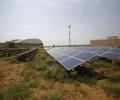
Adani Green Energy entered the list of top-10 most valued companies in terms of market capitalisation (m-cap) in the country on Monday after its stock price zoomed 16.3 per cent to hit a new high of Rs 2,701.6 on the BSE. Adani Green Energy's m-cap now stands at Rs 4.22 trillion, surpassing Bharti Airtel, which has an m-cap of Rs 4.16 trillion. With today's rally, the stock has zoomed about 25 per cent in the last two trading days after UAE's International Holding Company (IHC) agreed to invest Rs 3,850 crore in Adani Green Energy through preferential issue.

Rakesh Jhunjhunwala's holding value in Nazara Technologies crossed the Rs 1,000-crore mark. In the past one month, the market price of Nazara, a diversified gaming and sports media platform, has zoomed 78 per cent. In comparison, the Sensex was up 3 per cent during the same period.

Shares of Indian Railway Catering and Tourism Corporation (IRCTC) hit a new high of Rs 4,512 after surging 8 per cent on the BSE in Wednesday's intra-day trade, on the back of heavy volumes, ahead of 1:5 stock split. The trading volumes on the counter more-than-doubled today, with a combined 7.02 million equity shares having changed hands on the NSE and BSE till 11:19 am. In the past one week, the stock of the state-owned travel support services company has rallied 20 per cent after the company on September 29, 2021, said that it has fixed October 29, 2021 as the record date, to ascertain the name of shareholders entitled for subdivision/split of equity shares of Rs 10 each into five (5) equity shares of face value of Rs 2 each.
Shares of HCL Tech hit a fresh record high of Rs 1,118.55 on Friday, up 2 per cent on the BSE in intra-day trade, surpassing its previous high of Rs 1,101 touched on Thursday in intra-day deals.

The latest circular from BSE that sought to cap the price movement of select scrips, especially the mid-, small-cap segments, traded on the exchange is not without a reason. A quick calendar year-to-date price check on the stocks from the categories put under 'Add-on Price Band Framework' by the BSE reveals a total of 210 stocks have seen their market price more than double. Among individual stocks, SC Agrotech, Adinath Textiles, Waaree Renewable Technologies, Steel Strips Infrastructure, Unistar Multimedia, Texel Industries, Raja Bahadur International and Hindustan Everest Tools from the BSE's X and XT group have rallied over 500 per cent during this period. Topping the charts is Gita Renewable Energy, which has zoomed 3,964 per cent to Rs 272.35 now from Rs 6.7 as on December 31, 2020.

The retail frenzy over initial public offers (IPOs) seen over the past few months is not without reason. Over the past two years, 61 companies have tapped the primary market and raised funds via IPOs. Of these, 24 companies (nearly 39 per cent companies) have more than doubled at the bourses with Happiest Minds, IndiaMart Intermesh, Indian Railway Catering and Tourism Corporation (IRCTC), Affle India and Route Mobile surging 468 per cent to 722 per cent since their listing date till now. Retail participation in the equity market, according to analysts, has just reached an inflection point due to the low interest rate regime amid lack of investment-worthy avenues that can generate a good return for investors.

Mid- and small-cap indices have outperformed the frontline benchmarks - the S&P BSE Sensex (up around 10 per cent) and the Nifty50 (13 per cent) - in the first half of calendar year 2021 (H1-CY21) by rallying 26 per cent and 39 per cent, respectively. The trend, analysts believe, is likely to continue in H2-CY21 as well. The outperformance in H1-CY21 comes on the back of improved earnings and strong inflows from the foreign portfolio investors (FPIs) in Indian equities. However, good monsoon so far, gradual opening up of the economy and the pick-up in the pace of vaccination provides support to the market.

Shares of Adani Group companies were in focus during Monday's session, with four of the six listed stocks being locked in the upper circuit of 5 per cent, bouncing back up to 11 per cent from their respective intra-day lows on the BSE. Adani Green Energy (Rs 1,115.85), Adani Transmission (Rs 1,297.65), Adani Total Gas (Rs 1,321) and Adani Power (Rs 120.60) were locked in 5 per cent upper circuit on the BSE. Adani Ports and Special Economic Zone (APSEZ) and Adani Enterprises rallied over 7 per cent and 6 per cent, respectively, in intra-day trade. In comparison, the Sensex rose 0.44 per cent to 52,574.46 on Monday. Last week, all Adani group stocks had come under pressure after a media report suggested that the National Securities Depository (NSDL) had frozen accounts of three foreign funds that own stake in four of Adani Group companies.

Foreign brokerage firm CLSA initiated coverage on the stock with a Sell rating and target price of Rs 1,095, citing hefty premium valuation.

Around 75 per cent, or 372 stocks, that are part of the BSE500 are trading at least 10 per cent below their all-time high levels, despite the index hitting a record high 20,515 points on the BSE in intra-day trade on Wednesday, surpassing its previous high of 20,390 touched in March 12. The index, which accounts for 93 per cent of BSE listed companies' market capitalisation, has gained 8 per cent from its recent low of 18,983, touched on April 19. In comparison, the benchmark S&P BSE Sensex gained 6 per cent over the same period, but is still nearly 4.5 per cent away from its all-time high of 52,517 that it hit on February 16.

Shares of small-cap companies have been on a roll with the S&P BSE Small-Cap index hitting a new high in intra-day deals on Thursday. The rally has been fueled by an up move in stocks of chemicals, cement, graphite electrode makers, pharmaceuticals and information technology (IT) shares. In the past two weeks, since March 25, the index has outperformed the market by gaining 7.3 per cent. In comparison, the S&P BSE Midcap index was up 6.1 per cent, while the S&P BSE Sensex gained 3.6 per cent during the same period.

Thus far in FY21, BSE, NSE have rallied 70 per cent and 71 per cent, respectively.

Analysts attribute the surge to a host of factors, particularly the interest shown by the retail investors in these two market segments.

Analysts attribute this withdrawal trend to the nervousness ahead of US presidential elections and the fact that the markets raced ahead even as the economic recovery remained fragile back home.

The duo bought additional shares in pharmaceutical companies Lupin and Jubilant Life Sciences, along with Agro Tech Foods and NCC during Q2FY21

The S&P BSE 500 index, which accounts for 94% market capitalisation of BSE listed companies, has gained 45% from its March 24 low. However, out of the BSE 500 index stocks, 225 have underperformed the index by gaining less than the broader index during this period.

Among the lot, Rallis India, Escorts, Jubilant Life Sciences, and Crisil added half of the total gains made in the ace stock-picker's portfolio.
Experts say, investors will be better off exiting them at higher levels and investing in stocks of fundamentally sound companies.
Currently, the investor and his family's net worth in listed firms stands at Rs 8,517 crore, compared to Rs 8,388 crore as of March 31, 2020.

The S&P BSE Small-cap index has recovered 26 per cent as compared to a 23 per cent rise in the S&P BSE Sensex.
 © 2026 Rediff.com - Advertise with us - Disclaimer - Privacy Policy - Sitemap - Feedback - About us - Terms of use - Grievances